
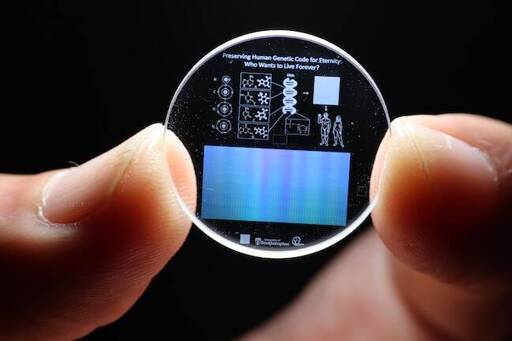
“the medium is silica crystal, similar to optical cable, it’s highly durable. It’s also capacious: The technology can store up to 360 TB of data on a 5-inch glass platter.”
“the medium is silica crystal, similar to optical cable, it’s highly durable. It’s also capacious: The technology can store up to 360 TB of data on a 5-inch glass platter.”
Images would likely be the easiest possible thing to translate compared to more arbitrary codes since in that situation the output should be more easily decodable?
Also, there’s plenty of easy solutions to that.
I thought it would be hard to reverse engineer the compression algorithms used in JPEG images. Or even understand what the data structure is supposed to be to begin with.
I agree. If easy accessibility for future archeologists was the goal one could maybe use 1 or more 2D matrices of scalar values to represent monochromatic images. Or just etch the pixels of the image itself in the medium - like we do with microfiche.
Why would you need to reverse engineer the compression algorithm? The output can be viewed without that. I don’t need to know how you got to my party to have a good time with you :)
IIRC the thing is, you first present the key to the structure in some simple form, and then the rest of the data can be more complex.
Like the question how one would tell a future generation to not go to a dangerous place? Like a nuclear waste dump. Slightly different topic, I know.
Communicating with someone whose language and mindset doesn’t exist yet could be tricky. But math could be possible.:)