

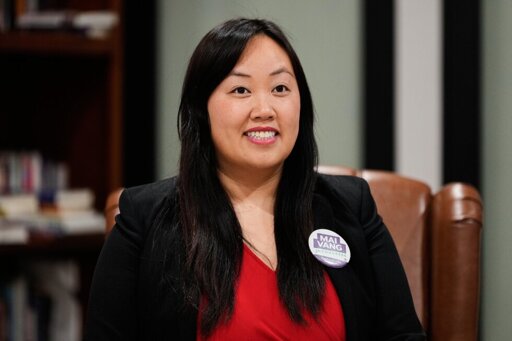
In Trump’s first term, grassroots Democrats focused their ire on the Republican president. But now, after President Joe Biden’s reluctance to step aside in 2024 at age 81 helped pave the way for Trump’s return to the White House, many see their party’s own veterans as part of the problem.
I mean, it’s absolutely a sign of weakness - which is to say, it’s a sign that the incumbent isn’t popular. The institutional response to an incumbent’s unpopularity is to mask it by forcing rivals out of the primary process (as with Biden going uncontested in '24).
In 1803, a single House Rep had a district of about 34,000 people. In 1903, a district held 193,167 people. In 1953, 334,587 people. In 2023, 761,169 people. These seats weren’t great at representing large-ish constituencies 220 years ago. They’re absolutely dogshit at it now. Members exist to represent the party on behalf of local party members not the people of the district. In many cases, a Rep is explicitly antagonistic towards minority members of their district in an attempt to curry favor with the majority.
The two year window is not about direct accountability to the district nearly so much as it is direct accountability towards the donor class that sponsors their campaigns. And the near-continuous need to fundraise in order to cover the cost of advertising and self-promotion within the district has turned House Reps into patronage positions of the most servile sort.
The problem with primaries, in the modern political equation, is that they drive up the cost for donors to hold any single seat. And for parties to control a House majority (as non-incumbents are more vulnerable to a seat flip).
So suppressing primaries, suppressing voter turnout, and suppressing opposition parties through gerrymandering are - at the end of the day - cost control measures for national parties and corporate interests.
They’re the best because at that age they’ve proven themselves to be unfailingly loyal. This is, again, an issue of cost control and risk mitigation. Nobody who has been in the Senate for 50 years is going to pitch any curveballs. Nobody who has climbed to the top of the ladder in their House Committee is going to deviate far from their proven ideology.
Unlike with freshmen who can waffle erratically from their original campaign pledges (see: Fetterman and Sinema, for instance) the 70 year old multi-election incumbent - a la Chuck Schumer or Diane Feinstein - is very predictable.