

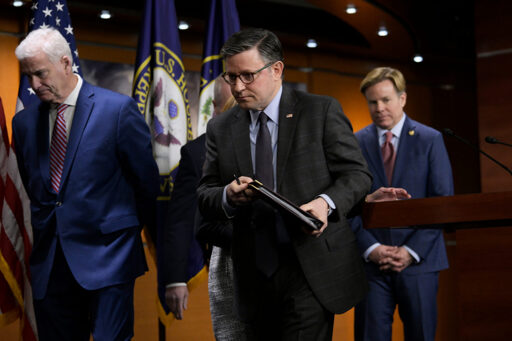
The GOP’s sweeping new anti-voting bill cleared the U.S. House Wednesday, setting up a high-stakes battle in the Senate.
The House voted 218-213 to pass the SAVE America Act, which experts have said could disenfranchise millions by requiring voters to show documentary proof of citizenship at registration and to provide photo ID when they cast ballots.
Republicans have argued for voter ID broadly, pointing out that there isn’t much to prevent a noncitizen from casting a ballot in a federal election — besides the fact that it’s a felony, easily caught, and would lead to deportation all for the chance to cast one out of hundreds of thousands of votes.
That the thing, and ID requirement sounds reasonable but it really isn’t in the US.
First, there is no national ID. The closest we have is out Social Security Card, but that’s just a number. There is no photo or other identifying information. Every state issues drivers licenses, but those can vary widely.
For example, Arizona drivers licenses don’t expire until the person is 65 which makes them terrible for identification purposes. Imagine looking at a driver’s license photo taken at age 16 and trying to figure out if that is the same 60 year old person standing in front of you.
There are birth certificates, but those alone aren’t positive identification either. There is no federal requirement to have one, though most people do. Still, there are about 60,000 babies born outside hospitals who may or may not ever get a birth certificate. These parents are often antigovernment and think they are doing their kids a favor by hiding them from the feds.
Then there is the issue of ID requiring a permanent address. Native American reservations do not get federal mail service, so they don’t have addresses. They use post office boxes to get mail, bit those aren’t valid for ID purposes. There are also people who live out of cars, RVs, or a simply homeless who nonetheless are citizens with a right to vote.
My partner had all their IDs lost in a fire., so I’ve gone through the process of getting a new ones and it is a nightmare. First, you need a copy of your birth certificate. But they won’t give that without some sort of proof of identity. That means we had to go to my partners gynecologist (the only doctor they had been to in this state) and get a letter swearing their identity and to their bank for proof of address. Then we could order a copy (plus fees) from their home state which we had to wait for a physical copy to be mailed.
Once that arrived, we were able to fill out the forms to get a temporary social security card (have to wait for the real one to come in the mail). After that we went to the Department of Motor Vehicles (which always has a huge wait) to present all the previous forms to get a state ID (a driver’s license would have required a written test, an eye test, and a driving test as well).
This all took us a couple hours a day for more than a week of going to various offices, being told we needed other forms, getting those forms, coming back, and so forth. Imagine trying to do that with a car, or in a rural location where offices could be an hour drive apart, or trying to do that while holding down two jobs.
The general point I am making here is that if you are poor, a minority, rurally located, or simply someone who falls outside the average, getting an ID can be a significant hurdle to the basic democratic right to vote.
That’s just wild from my perspective. In here pretty much everything works with your SSN and some way you can prove it’s yours. Healthcare, pensions, schools/education in general, taxes, benefits and nearly all publicly funded things require that you can prove you are who you claim to be. Hell, I can’t even get certain type of packages out of the post office without a valid ID.
Sure, there’s some burecrautic annoyance to actually get valid ID card or passport, but compared on what you’re saying it’s walk in the park. Last time I renewed mine it was enough to submit application for it digitally and then visit a police station to actually confirm my identity for that application, but in total with traveling it took 2-3 hours.
And also I can verify my identity online pretty easily either via my bank credentials or with a phone service. For me and a lot of other people it’s really convenient, but obviously in here we also have people who can’t (or won’t learn to) use all the new tech so for them some things have gotten more difficult.
A fun side-note is that today my driving license actually doesn’t qualify as valid identification. On some cases it’s still enough and it used to be as good as actual ID card but with a ton of EU drivers licenses from other countries around it’s not ‘strong’ enough identification anymore.
The United States works a lot more like the EU than any individual country. Each state has its own politics and leadership. Some states try to make things easier, some try to make things harder, and it can all flip from one election to another. It makes it very hard to make any kind of progress. A passport would work as ID just about anywhere, but less than half of Americans have one. I don’t (and I’ve been out of the country a couple times).