

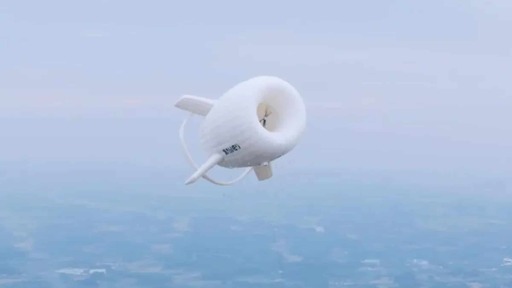
The S1500 floating turbine’s operating altitude is 4,921 feet above ground level, where wind speed moves about three times faster than at the surface. The advantage of this altitude (also referred to as vertical slice) can result in a power output up to 27 times higher than a conventional ground-based wind turbine of similar capacity.
The capacity to generate one megawatt of electrical power (MW) with the S1500 system is comparable in size to what small wind power turbines normally generate (a conventional 328-foot-tall wind turbine), while the footprint of the S1500 system is significantly smaller. This amazing power density shows the efficiency benefits of being able to access high altitude wind power resources by new and innovative airborne platforms.
The wind at 32,000 ft is 200 times stronger than the wind at the surface?
Ummm… 10 knots * 200 = 2000 knots. I don’t think so lol.
A lot of strange numbers in this article that bring its accuracy into question.
No mention of the weight of a 1 and 1/2 km wire that is also suitable to anchor this thing in place. Or are they going to float batteries and bring them down to discharge?
First of all, kinetic energy scales with the square of an objects velocity.
Second, since we’re talking about a continuous stream of fluid instead of a single object, increasing the air speed not only increases the enegy per unit mass of air, but also the number of units of air per second that pass through the turbine. Which means that the amount of energy extracted scales by the cube of the wind speed.
https://kpenergy.in/blog/calculating-power-output-of-wind-turbines
So, more like going from 10 knots to 60.
Didn’t think about the possibility of a kinetic energy unit, thanks for the insight
I can’t be arsed to dig up the equation, but it may mean that the wind has 200 times more usable energy, which I think is a cube function of its speed. Wouldn’t be 2000 knots in that case
they gonna use magsafe connectors for wireless transmission, duh.
You’re starting to sound like a chatbot now, MagSafe connectors aren’t wireless. That’s the point!
(I know you’re probably not a chatbot)
Maybe it means the kinetic energy of the wind, which I believe scales against its velocity-squared?
I’m thinking it’s about consistency. 10kts 10% of the time vs average 150kts 100% of the time (the math is a little off but we’re in hypothetical estimates already)