Isn’t that the distinction anyway, at its core ? you could count grains of sand, but it would just be too fuckin impractical, not to mention pointless.
Disclaimer : I don’t usually math. I barely know what numbers are
Not quite. Mathematicians realised that “counting” is just defining relations between sets of things and sets of the form {1,2,3,…}, in such a way that every thing gets assigned 1 and only 1 number.
Usually, the relation is defined by pointing to each of the things we want to count and saying the number we’re assigning to it. However, using this whimsical definition of counting allows us to define the relation in equally whimsical ways and “count” stuff we normally wouldn’t be able to, however impractical (or even infinite). For example, we know we can “count” the natural numbers, even though they’re infinite, because we obviously can assign a number to each one of them, namely themselves. But did you know we can also “count” the rational numbers? The thing about the reals, though, is that not only we haven’t been able to find this relation, but we actually proved that it’s impossible to find. The proof isn’t actually hard to follow so I recommend you check it out.
You can’t count sand unless you specify a unit to count, as you did by saying “grains” of sand. You can’t count “sands” because it’s unclear how much sand counts as “one sand.” Is it grains? Molecules? Grams?
Keep in mind, units can be implicitly rather than explicitly stated. If you ask a waiter to bring two waters to the table, they’ll understand from context that you want two glasses of water.

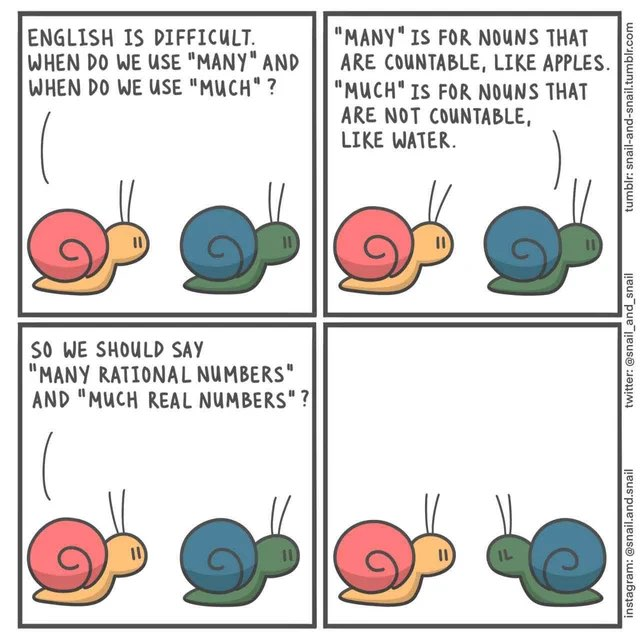
You very much can count real numbers. You just can’t count all of them.
Isn’t that the distinction anyway, at its core ? you could count grains of sand, but it would just be too fuckin impractical, not to mention pointless.
Disclaimer : I don’t usually math. I barely know what numbers are
Many grains can compose much sand. But you’re right, I think. We don’t think of sand as grains, but as a substance, and say “much sand.”
Very sand ! much grain !
Not quite. Mathematicians realised that “counting” is just defining relations between sets of things and sets of the form {1,2,3,…}, in such a way that every thing gets assigned 1 and only 1 number.
Usually, the relation is defined by pointing to each of the things we want to count and saying the number we’re assigning to it. However, using this whimsical definition of counting allows us to define the relation in equally whimsical ways and “count” stuff we normally wouldn’t be able to, however impractical (or even infinite). For example, we know we can “count” the natural numbers, even though they’re infinite, because we obviously can assign a number to each one of them, namely themselves. But did you know we can also “count” the rational numbers? The thing about the reals, though, is that not only we haven’t been able to find this relation, but we actually proved that it’s impossible to find. The proof isn’t actually hard to follow so I recommend you check it out.
You can’t count sand unless you specify a unit to count, as you did by saying “grains” of sand. You can’t count “sands” because it’s unclear how much sand counts as “one sand.” Is it grains? Molecules? Grams?
Keep in mind, units can be implicitly rather than explicitly stated. If you ask a waiter to bring two waters to the table, they’ll understand from context that you want two glasses of water.