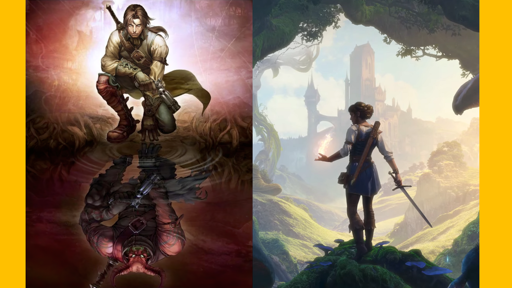
TL;DR: The new Fable game removes the traditional good and evil morality system, focusing instead on a location-based reputation that changes with each settlement. Players won’t alter their appearance based on deeds but can customize their hero’s look with cosmetics and gear.
I don’t really care if they want to rework the good/evil system. What sucks is that they took out the body morphing completely so your character model won’t change with the skills they’re acquiring. Seems like a lazy choice, and doesn’t bode well for the rest of the game IMO.
Thanks for the TL;DR. The title led me to believe the post was going to be clickbait built off a nothingburger and it seems I was right.
I don’t think the headline is fair at all. I think it’s there, just reimagined. And personally I think it sounds really cool. If I want the old system, I can play the old games.
Well, if I get what they’re doing this time, it’s different.
Heroes in Fable are driven by narrative forces, they are supposed to be literally heroes of a fable. Morality in these games is not reputation, it’s not supposed to be realistic, it’s like a natural law of the world. And, along with a few other character development traits, morality changes your character physically.
You can even “boost” your evilness with stuff like eating live chicks. Nobody witnesses you doing that.
There’s a whole shtick in Fable that sets it apart from most RPGs, in that, Fable never even pretends you’re a character among others. You’re one of 5 or so heroes destined to shape the story, and the rules applying to you are just different from everyone else.
It sounds like this time, they’re going for something a lot more classic, i.e. scoring how people feel about your choices.
What do you think I meant by reimagined?
Probably what they wrote.
Not sure, but I certainly don’t get “it’s there” from “there is something else instead that feels completely different from the original design”.
We’ll have to agree to disagree about it feeling completely different then! Not least of which because I haven’t gotten to feel it at all, since it’s not out. It looks very cool and fun imho though! Still think the headline is unfair.
Right? Also it’s not like the mechanic is universally loved. The good vs evil decision features of games (like in Fable, Infamous, Knights of the Old Republic, etc.) are often heavily criticized for being obvious, simplistic, forced, and sometimes even punishing to some play styles or mistakes by restricting some skills behind one alignment or the other.
I liked it as a mechanic personally, but I am also interested to see how the new evolution on the mechanic works. Maybe it’s shit, maybe it’s a more nuanced version of the old one. We’ll see.
A welcome change imo. The morality system in the Fable games were always heavily lopsided, with one side being strictly superior than the other. Though I will say that I did like the cosmetic changes it made.
Thank good the chicken kicking is still there
So basically like what Obsidian did with New Vegas reputation system after Fo3’s simplistic karma system.
new vegas still had karma for some reason. really makes it hard to be evil non legion
I liked what Mass Effect 2 did. Scars that healed if you did good deeds and got worse if you were evil. Or you could pay to upgrade your sick bay, remove the scars, and disable the feature entirely. I roll paragon on the Normandy, but I removed the scars.
Morality systems are easy to break anyway.
I love that some games allow you to essentially trade money for morality, just like in real life!
If you can’t be good, be a capitalist, then dump some of it when you need a PR boost - maximise efficiency.
That’s exactly how we got all the achievements in Fallout 3 in one run. We as in, the Fallout community and achievement hunters — I’m much more of the former than the latter, but there is some crossover between the two.
There were 9 karma achievements. Reach level 8, 12 (or 14, or 16, I forget which now), and 20 (the original cap; it was raised to 30 with the Broken Steel expansion and there was a non-Karma connected achievement for hitting 30) with Bad, Neutral, or Good karma. Here’s how we got all nine in one run: We’d play Evil, basically stealing everything not bolted down and whatnot. Also, playing Evil in the beginning unlocks one of the first companions you’ll meet, in the first town. He won’t run with you if your karma is neutral or higher. Anyway, just before hitting a requisite level, we’d make a hard save. Hit the level, pop the evil karma achievement, then reload it, go to the nearest church (there was one in Megaton, one in Rivet City, and maybe there was one other?), and donate caps by the truckload. Being evil, we had the caps (money) to do it. Pop the neutral one, then the good one… then reload that hard save and continue as evil. And then repeat the whole dog and pony show with each achievement-based level.
Morality systems are easy to break anyway.
I would say its more that morality systems are hard to implement.
If you make simple system where you loose karma from stealing and gain karma from donating money for orphans player can exploit that system easy. You would need to figure some other system. One could be system where after stealing or donating a certain amount you get a status that permanently raises/lowers your karma. But it really cant be permanent either because it takes away from player agency. How would you turn those things to a points. I mean stealing last coin from beggar cant be same that stealing a coin from a millionare. Also this kind of karma system makes so the quests in the game are black and white. You cant make a quest where dooming 12 orphans to die saves thousands from a plague.
How to implement the karma? Everybody magically hating you for low karma is just unrealistic. Should karma effect only some random events and set story points? Sounds fine, but then devs need to implement that system to the storypoints and its not easy to do so without railroading the players. Like Paragon/Renegate in mass effect 2. It made it so everytime the opportunity came to choose from the two, it took away from the real choise and it became just desition to wich stat you want to raise. Also choosing neutral choice was never good option, because in the end game you need to have one or other stat high enough to get trough gated discussions. You could roleplay and choose what ever you feel right, but then some late game options are just locked from you.
I think Elex did it pretty good. Subtle but visible.
Was it any good game? It has been sitting in my library for ever, but i heard its kind of meh, so i have been putting it of.
It’s ok. With faction relations and stuff. And cobbling up a troll with a jetpack and a legensary sword has something. While the lore is ok. But you need a reshade to get rid of the “gray fog”, especially in the swamps. I mean the 1., didn’t play the 2. yet.
One might argue that KOTOR semi-ruined a generation of video games with morality systems. I’m one. I would argue that.
Yeah, I fucking detest the way morality systems in games work.
I don’t think they’re a fundamentally unworkable idea, but very few games have even come close to doing anything good with the concept.
Most just offer you two equal but different benefits, let you pick between them, and call that morality. See Bioshock. And the Mass Effect / KOTOR system always sucked because it punished you for going down the middle (ie, playing a complex character).
One of the only good morality systems I’ve ever seen is Metro 2033. For those who don’t know, the game has a secret personality tracker. It gives you points for taking actions that are pro-social. You get a lot of opportunities in the game to refuse benefits or give up resources to help others. You are never directly rewarded for this. It doesn’t do the bullshit where you give someone some food and they go “Here’s an old gun I had lying around.” Being kind costs you. It also measures the time you spend interacting with people, listening in on conversations, that kind of thing. Just generally giving a shit about other people. By the end of the game, if you’ve played your character like someone who cares about other people, you get an opportunity to make a better choice in a specific situation, that leads to a better outcome. If you don’t, the choice is never presented to you at all, because the character you portrayed wouldn’t even think there was a choice to be made in that situation. It’s brilliant, and it completely solves the usual Deus Ex / Mass Effect “Three buttons” ending where nothing leading up to it matters. To be able to make the good ending choice you have to have played the kind of character who would be willing to make that choice in the first place.
Then Kreia came and deconstruct the entire morality of Star Wars…
If only more people had heeded her message, we wouldn’t have ended up with the “morality” system of Infamous, where it was such a hard choice to either save these people or harvest their energy for your own gain. Decisions, decisions.
“We all have our heroes. And when we watch them fall, we die inside. She made a choice once… and I did not.”
“It is such a quiet thing, to fall. But far more terrible is to admit it.”
With dialogues like these binary morality system just seems dumb.
Oh yes, and I put these two quotes together to mirror how both Kreia and Atris made their choices.
I’m not convinced by the trailer/gameplay we’ve seen so far as it just
feelslooks so bland to me. Hopefully I’m wrong.“looks so bland to me”
So… It’s a Fable game then?
Seriously, when has this series ever been anything other than the unseasoned oatmeal of RPGs?
Yep, the first game was ok, nothing special, didn’t feel anything afterwards. I am feeling the same now.
Its not gone, its just more nuanced