As we all know, file copying on Linux has long relied on the classic cp command, which remains reliable but offers little feedback and limited control over long or complex operations.
To address this, a promising new Rust-based command-line tool called cpx emerge, designed as an alternative rather than a replacement, that approaches the same task with a focus on performance, visibility, and configurability.
It targets scenarios where large directory trees, interrupted transfers, or the need for detailed progress reporting make standard tools less convenient to use. The project is currently Linux-only and leverages modern kernel features to improve copy throughput and reliability.
New Linux util.
looks inside
Non-copyleft license
I appreciate that it’s not trying to replace
cpbut the lack of copyleft is always disconcerting.What’s the risk here though, a company like Amazon makes a closed source version of it?
If it was a file format library, or something like a web server I’d get it. But stuff like
cpare effectively just userspace wrappers around kernel APIs.yeah, like, supposedly it can be hard to use GPL with some rust dependencies, but the MPL is right there as a decent compromise.
how can it be hard? permissive licenses are compatible to the GPL, the opposite not though
Static linking makes things difficult. I’m not sure what the details are, that’s just what I’ve heard from Rust developers.
Because of static linking, a single GPL dependency turns the entire resulting binary into a GPL licensed one, so yeah just use something like the MPL in that case (Or EUPL, which I hear is similar)
LGPL has the same issue, since it only provides an exception for dynamic linking. But honestly that’s all an issue for lawyers and judges to sort out (I bet you could win in court with an argument that dynamically linking to GPL is actually fine).
I like and use rust, and I actively try to use permissive licenses for libraries and copy left for binaries. Just makes sense in my head.
I like and use rust, and I actively try to use permissive licenses for libraries and copy left for binaries. Just makes sense in my head.
I always find choosing a license confusing.
If you’re up for it, I would love to read why you use this guideline.
I want people to use the software I write, and people don’t want dependencies in their projects that are gpl because you either need to change your project to gpl or go through a very tedious process of providing object files for the entire project. That’s why I use mit for libraries.
However, I don’t want to allow companies to just take my finished binaries and resell them as their services, so I use GPL for binaries and apps. They are free to reimplement the app using the libraries, but I at least want them to work for it a little.
Also, I have found it easier to get contributions to projects that are licensed under mit than gpl, though this might just be insufficient sample size.
Food for thought. Thank you!
What’s wrong with rsync?
apparently gets a 2-5x speedup over rsync +nicer interface
It’s a damn pain to remember all the flags. How many flags can a program friggin have? I’m always afraid that some flag I enter will reverse the sync and delete everything in the source folder because the target is empty.
I use rsync only when all params have been reseasrched and tested. cpx presumably just requires
cpx - r source targetinstead of 5 rsync flags.I’m always afraid that some flag I enter will reverse the sync and delete everything in the source folder because the target is empty.
A version of
rsyncwithout this risk would be a killer app. Haha.The only one you need is -a. -avz if you want verbose and compression.
–progress=info2 could be a bit shorter imo
I just looked it up and - x means one filesystem. But does - v give you a progress bar or just a lost of stuff copied?
IIRC rsync also treats the trailing slash in a special manner that I always have to look up.
The trailing slash is just following cp’s own special treatment
# before dir/ file1 target/ orig.txt # no trailing slash - copy *dir* to target cp -r /path/to/some/dir /my/target # after target/ orig.txt dir/ # dir copied to target file1 # with trailing slash - copy *contents* of dir to target cp -r /path/to/some/dir/ /my/target # after target/ orig.txt file1 # contents of dirHa. I meant z. I guess I was getting mixed up with tar.
No slash means the directory. Slash means the items in the directory.
What 5 flags did rsync need? I always just do -av and go about my day. And the -v is kinda optional.
How do you get the progress bar?
--progress🤷♂️
I’ve had cp aliased to rsync with my flags for years. It seems like a lot of newcomers try to “fix” stuff before they really understand what’s available. Or they just like to play around with different programming languages. Which is fine, but usually it’s not really interesting to me.
you seem to have added a condescending comment before you understood the goals. 2-5x speedup over rsync (their benchmarks, but still) seems significant on its own, and an interface that doesn’t require aliasing to be useful is also nice
That’s probably the next wheel some overzealous Rust dev will reinvent.
Too many letters to type obvi! /s
MIT License 🤢🤮
What’s wrong with the MIT License? It’s one of the most permissive licenses out there. I don’t see how a copy-left clause like others are saying would change things. If someone wants to compile this in to their own proprietary file explorer or something, who cares? Everyone still has access to the original.
What’s wrong with the MIT License?
Good question.
Failure to copyleft contributes to “embrace extent extinguish”, which many of us feel is a constant threat to the ecosystem of our favorite tools.
For example, Google can make a better expanded XMPP client, and keep extending it until the open XMPP clients are no longer compatible - drawing most of the userbase away from the free open ecosystem. (Source: I fell for that shit, and I lost track of dear friends who I used to regularly chat with over XMPP.)
MIT license also risks security patches being written by big corporations for their own use, and not getting contributed back to the commons.
I’m not really sure these risks particularly apply for a ‘cp’ variant, honestly.
But I’m onboard now with not making anything unnecessarily MIT license.
Google could have done that from the spec though. Google is doing that with chromium despite the source being entirely available
even agpl wouldn’t protect this tool in most cases if a company didn’t want to contribute back, since it’s probably just used in server side scripts and such. also companies aren’t required to upstream stuff, just make source available, which means hard to discover ftp site with a pile of code.
sure something more copyleft is better for large, more commercial projects, but this in particular probably gets more patches from the extra use in the rust community from MIT than they would forcing companies to open source changes
Welcome to rust where MIT is just recommended yet everyone does use it for licensing.
I’m aware that they are wrong
ezafd-findWhich other modernized tools to get and enjoy fam?
So many things from the Modern UNIX tools repo!
My daily drivers are:
lsdinstead ofls- colors, icons, tree-view, more formatting,dustinstead ofdufor better formatting,jqfor viewing JSON,gtopinstead oftopjust because it’s so pretty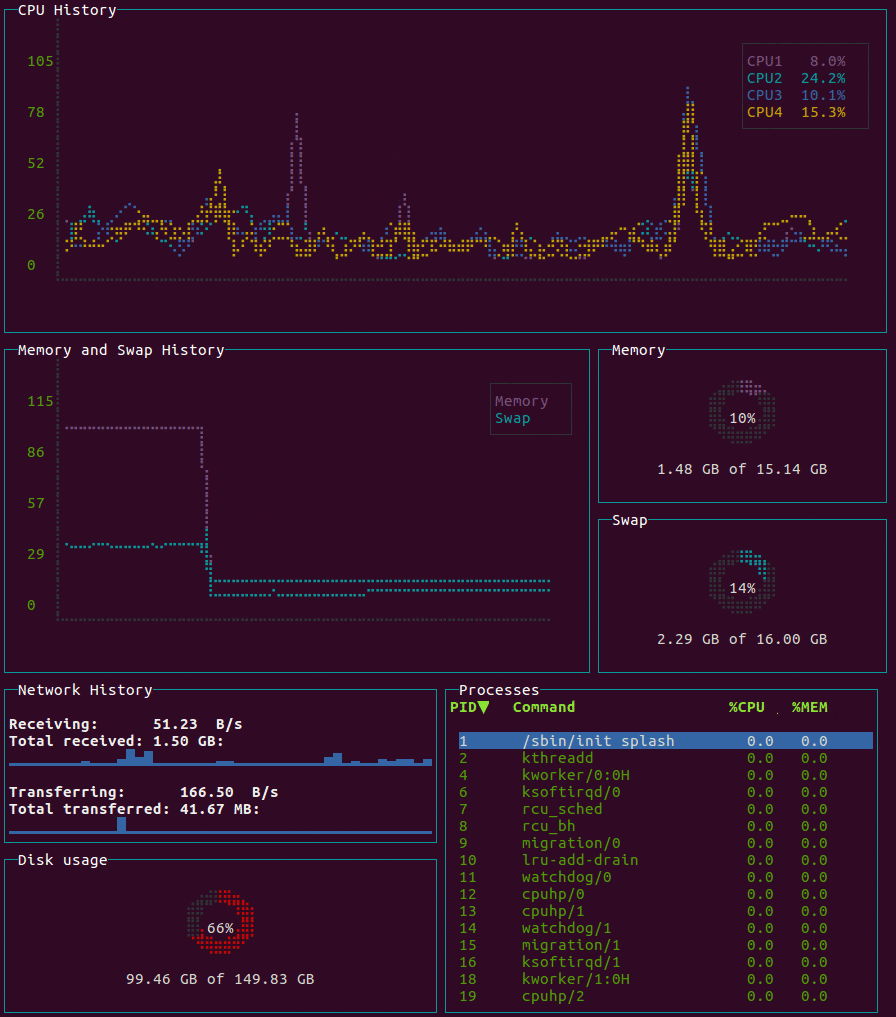
(I’ve aliased most of these, but there are a few toolchains that have broken)
Thanks for sharing this!
If you have (or start) a blog with RSS, please let us know. I would be down to read more of these tips!
I’ve been using btop, this seems interesting
That
dustis looking fine. I have been usingbtopmyself.I find btop’s color schemes don’t work well with changing between light and dark mode in the terminal when theme background is turned off.
This is very true. I find
flat-remix-lightto be somewhat decent (still pretty bad) among the options.Okay cool, I’ll test that out. Thanks!
Hope it works for you
Oof zoxide is my baby. One of the best new utils.
also ripgrep and fzf.
check out this blog post I wrote about cool TUI and CLI tools I use. Not all of them are “modernized” but you’ll find some cool things there.
dustandripgrep