
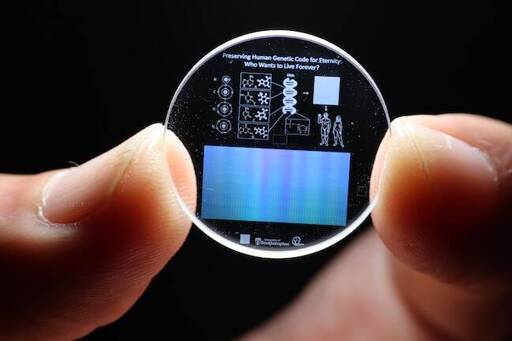
“the medium is silica crystal, similar to optical cable, it’s highly durable. It’s also capacious: The technology can store up to 360 TB of data on a 5-inch glass platter.”
“the medium is silica crystal, similar to optical cable, it’s highly durable. It’s also capacious: The technology can store up to 360 TB of data on a 5-inch glass platter.”
Good luck finding a reading device for it in 100y, let alone 14 billion years. I doubt there will be a human civilization a few thousand years from now. :)
Remember how humanity had problems understanding the meaning of ancient egypt hyroglyphs from just a few thousand years back until The Rosetta stone was found and some really clever and dedicated guy put an awful lot of work into the translation? Good luck with JPG images or pdf documents or even ASCII text.
It’s OK to make fun of non-existing/ not yet market ready devices, no?
I was actually thinking whichever company bringing this for the masses will abandon its support 5y later and 25y from now we won’t be able to read it at all, let alone decode the bits.
As long as as humans haven’t succumed to brainrot and still have capacity for math and logic, we can figure it out. It’s encoded, not encrypted.
The classic problem of long-term nuclear waste warning messages is about conveying information over cultural barriers. This is a concrete data type, not interpretation of vague contexual meanings from pictograms. Math and logic don’t change while cultures do. Images are far more retrievable than the meaning of an image.
Wait until humans find a way to divide by 0. Suddenly Cambrian explosion in science, immediate Warp civilization and whatnot.
Then they find this chip, but cannot decipher it, because they don’t understand mathematics not able to divide by 0 😅.
Images would likely be the easiest possible thing to translate compared to more arbitrary codes since in that situation the output should be more easily decodable?
Also, there’s plenty of easy solutions to that.
I thought it would be hard to reverse engineer the compression algorithms used in JPEG images. Or even understand what the data structure is supposed to be to begin with.
I agree. If easy accessibility for future archeologists was the goal one could maybe use 1 or more 2D matrices of scalar values to represent monochromatic images. Or just etch the pixels of the image itself in the medium - like we do with microfiche.
Why would you need to reverse engineer the compression algorithm? The output can be viewed without that. I don’t need to know how you got to my party to have a good time with you :)
IIRC the thing is, you first present the key to the structure in some simple form, and then the rest of the data can be more complex.
Like the question how one would tell a future generation to not go to a dangerous place? Like a nuclear waste dump. Slightly different topic, I know.
Communicating with someone whose language and mindset doesn’t exist yet could be tricky. But math could be possible.:)
We still have Ford-Ts that are alive and kicking so pretty sure in a 100 years some museum will still have a working reading device for this. If this ever comes to market. Also the claim is just to ensure businesses that their backups on this medium will still be 100% readable in a couple of decades, even when the medium hasn’t been stored properly. Unlike tape that has a good chance to rot after 5 years. If it lasts a billion years it surely will survive some damp forgotten basement room for a few decades.
Fair. I agree with your arguments.
But I tried to clarify that I’m making fun of a not yet market-ready product (many are just fantasies to collect investor money and there won’t be a product ever.) and its exaggerated claims by pointing out that the sun will have died by then and no one cares about your excel sheets anymore. And more practical limitations like missing software and devices to read and understand the contents in a much shorter time frame. I exaggerated back if you will. ;)